Tampilkan postingan dengan label Trayvon Martin. Tampilkan semua postingan
Tampilkan postingan dengan label Trayvon Martin. Tampilkan semua postingan
Sabtu, 16 Juni 2012
Selasa, 29 Mei 2012
Playing Dead: The Trayvoning Meme & the Mocking of Black Death
 Playing Dead: The Trayvoning Meme & the Mocking of Black Death
by Lisa Guerrero and David J. Leonard | NewBlackMan
The more things change, the more they stay the same. While new media and social networking is “transforming” our society, in certain ways, bringing people closer together, if only seemingly so, its “newness” seems only relative to its potential as a new frontier in which to deploy and recycle the same old narratives and tropes, to continue a history of injustices that define the American experience. As the technologies of communication appear new, the technologies of oppression are anything but. However, as we see with “Trayvoning,” the trend that has White youth posting pictures of themselves as if they were part of the Trayvon crime scene, the marriage of communication innovation with racist stagnation does constitute something new, though not improved, in the history of the system of racism in the United States.
“’Trayvoning’ is when you get a hoodie, Skittles and Arizona iced tea, and pose like you've been shot in the chest.” The Facebook page instructs participants in go through the following steps:
1. Get hoodie
2. Get skittles
3. Get Arizona
4. Wear hoodie
5. Go to Florida
6. Get shot :)
Trayvon Martin was a 17-year-old African American male who was unarmed and got shot by a raciest [sic] Mexican American.
During Step 7, participants are instructed to post their pictures on the Internet, which has led to widespread circulation of these disgusting and dehumanizing images.
In response to reports about “Trayvoning,” Jasiri X asked on Twitter: “Trayvoning? Really? Why is our pain, suffering & death, always mocked for laughs?” This question gets to the heart of not only the efforts to recreate and disseminate representations of the Trayvon case, but it is also a means to communicate pleasure in the murder of Trayvon. “Trayvoning” recasts and performs injustice by turning someone’s pain and suffering into a spectacle of white pleasure that further denies the humanity of black people. This is reflected not just in “Trayvoning” but with the Orlando businessman who has sought to capitalize by selling Trayvon shooting targets, the media that continues to criminalize and blame Trayvon, and those who have disparaged, mocked(see here for picture of someone who donned blackface), and made light of a dead young man.
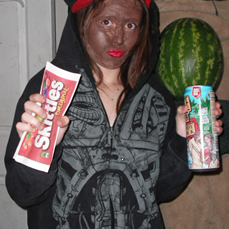
The disregard for Black life, and the disparagement of Black death is nothing new; the pleasure and joy garnered from Black suffering and dreams deferred has been central to White supremacy throughout United States history. Evident in minstrel shows, the history of lynching, and jokes about racial profiling or the war on drugs, whites have always found joy in the violence experienced by African Americans.
The history of American public discourse is one marred with both the erasure of black and suffering, and efforts to find happiness and pleasure in the suffering of the OTHER. We saw this during Hurricane Katrina where the sight of African Americans wading through water in search of food or medicine, or stranded families clinging to life on roof tops elicited reactions of shock and horror as well as pleasure and joy at the knowledge that could never happen to White America. Dylan Rodriguez describes Katrina as a “scene of white popular enjoyment, wherein the purging/drowning of black people provided an opportunity for white Americana to revel in its entitlement to remain relatively indifferent to this nearby theater of breathtaking devastation.”
Such joy isn’t simply an outgrowth of the denied humanity of Black people or the refusal to witness and see Black pain, but it is also a celebration of, or at least the solidification of, White humanity, White power, and the protective armor that whiteness provides each and every day. This is the story of race in America, from lynchings to Katrina, from slavery to Trayvon Martin.
But the examples of racialized disregard that have surrounded Trayvon Martin’s death, most recently exemplified in the commodification and “meme-ification” of the tragedy by various White people. This marks a startling new mechanization of racism wherein there has been a complete evacuation of humanity…on both sides, that of people of color and other marginalized groups, the dehumanization of which is, sadly, no longer surprising, but also that of dominant groups who willfully participate in acts of oppression like “Trayvoning” whose humanity becomes increasingly and insidiously taken over by consumption and performance. The joy historically, as well as contemporaneously, taken by many Whites in the violence against and suffering of African Americans has become nearly indistinguishable from the joy of consuming.
The consumer market has overtaken all facets of social interaction, the good, the bad, and the very bad. We are witnessing a descent into a “society of the spectacle” that perhaps Guy DeBord himself could scarcely imagine. The spectacularizing of racialized events and tragedies within the 21stcentury, while still largely constructed through sociocultural lenses of White supremacy, racialized inferiority, and histories of racial injustices and violences, allows for their translation to be conveniently dislocated from these racial phenomena and displaced onto the assumed “neutral” projects of commodity and consumption. As DeBord stated regarding the nature of the society of the spectacle, “The spectacle cannot be understood as an abuse of the world of vision, as a product of the techniques of mass dissemination of images…It is a world vision which has become objectified.”
Writing about the practice of whites collecting body parts as souvenirs during lynchings, Harvey Young, in “The Black Body as Souvenir in American Lynching,” highlights the spectacle of white-on-black violence and the pleasure derived from Black suffering and death. He describes the lynching of Sam Hose in 1899, where, “the assembled crowd descended upon his body and collected various parts of it assouvenirs.” Seeking to explain the unexplainable, to provide meaning to the unthinkable, Young identifies this history in the following way: “lynched black body in the aftermath of the lynching event and variously read it in terms of the souvenir, the fetish, and the performance remain.” He argues, “that the lynching keepsake not only can be defined by, but also can exceed, each of these three terms. Containing within itself the various features of the souvenir, the fetish, and the remain, the body part recalls and remembers the performance of which it is a part. It not only gestures toward the beliefs that motivated its theft, but also renders visible the body from which it was taken.”
It would seem that the efforts to recreate Trayvon’s death, to trivialize his death by including skittles and ice tea, and then disseminate this image within the new media sphere continues the history of rendering Black death as souvenir. “For white supremacists, souvenir lynching photos became ways of reliving the erotic thrills of torture and mutilation produced under the guise of righteous civic actions, as well as a way of reaffirming a racial and gendered hierarchy that kept white men on top and blacks at the bottom,” writes Dora Apel in “Torture Culture: Lynching Photographs and the Images of Abu Ghraib.” She furthers that, “When lynching photos were transformed into souvenir postcards, they were sent to friends and family with the senders' proud boasts of having been in the mob, making blackness an exotic spectacle and privileging the ‘look of whites over blacks. Spectacle lynchings similarly relied on the look of the crowd to reaffirm notions of superior white ‘manliness’ over the stereotype of the hyper sexual black male”
In this historical example we see the explicit rendering of White supremacy. The White supremacy and racism of the act, purposefully done as the dual act of White superiority and Black inferiority, as well as of the racist and violent talisman provided by the souvenir, was never obfuscated. It was seen as a right. It was claimed. In the new millennium, a time heavily invested in the belief in its own racial progress, while remaining heavily mired in colorblind racism and reimagined racial violences, the rampant consumer society, fortified incalculably by new media, makes the claims to White supremacy, (for all but the most extreme), almost completely deniable. The claims become subsumed beneath the “logic” of the spectacle wherein “the spectacle aims at nothing other than itself.” (DeBord) This is the sociocultural state in which “Trayvoning” exists, the state of the self-referential spectacle.
Thus “Trayvoning” creates a community bound by whiteness and the ability to “become” Trayvon through the dehumanizing ritual, through the spectacle of Black death, and through recasting his murder apart from white supremacy and whiteness. While his murder, his death, and the circumstances that surround the injustice are understood as a site of White ritual and pleasure, a space of White pleasure resulting from Black pain, they are not transparently claimed (by and large) as such. While the trend can be interpreted as a new technology of lynching, its character remains separate from lynchings of the past whose act, and the dissemination of lynching photographs highlighted White power and White supremacy.
The ability to “act” like a dead Trayvon Martin only to get up and head back into White suburbia is illustrative of this same feeling of power and privilege, but invisibly so. White people don’t take part in “Trayvoning” to “declare” White supremacy; they take part in it because the declaration has been rendered unnecessary by various sociocultural, sociopolitical, and socioeconomic forces. In fact, the absence of the explicit claims to it emphasizes the power and privilege even more. It reflects an unstated joy at the lack of possibility of getting suspected as a criminal for merely walking to a convenience store; it reflects an unacknowledged level of pleasure in knowing that being stopped for walking while White is less likely than a visit to Newt’s moon colony; it reflects a flaunting of the power and privilege that grants Whiteness protection from armed security guards, an unwilling/reluctant criminal justice system, and a media culture more concerned with convicted Trayvon Martin than George Zimmerman. The ability to stand up and walk away after the photo indicates the power of whiteness.
“Trayvoning” is thus akin to a history of racial cross-dressing and minstrelsy, practices that, according to Eric Lott, embodied white desire “to try on the accents of ‘blackness’ and demonstrates the permeability of the color line.” He writes that blackface “facilitate[s] safely an exchange of energies between two otherwise rigidly bounded and policed cultures.” The ability to imagine and embody Trayvon in death is a source of pleasure because it not only provides whites with the opportunity to “try on” and “control” blackness but to reassert their whiteness. Whereas Trayvon is dead, whiteness lives on.
Much of the media discourse has likened “Trayvoning” to planking or “Tebowing,” emphasizing the phenomena as a spectacle, as yet another example of youth culture, the ease that pictures are disseminated on the Internet, or how trends come about. Yet, while “Trayvoning” is certainly a disturbing phenomenon of spectacle, these comparisons are absurd at so many levels because neither “planking” nor “Tebowing” rely on, perpetuate, and relish in Black death; these practices don’t find recreation in the re-creation of black suffering nor do they produce souvenirs to remember the death of Trayvon Martin.
“Trayvoning” is but another moment in a larger history of racial violence, and white efforts to establish a segregated community based on power and pleasure, commodification and deniability. One can only hope, based on the resistance and condemnation these pictures have elicited, that those thinking about “Trayvoning” will simply skip steps 1-6 and go right to step #8: humanize death, ANY death, instead of spectacularizing it; and continue to protest racial injustice in this form…and in all its forms.
***
Lisa Guerrero is Associate Professor of Comparative Ethnic Studies at Washington State University Pullman, editor of Teaching Race in the 21st Century: College Professors Talk About Their Fears, Risks, and Rewards (Palgrave Macmillan, 2009) and co-author of African Americans in Television, co-authored with David J. Leonard. (Praeger Publishing, 2009).
David J. Leonard is Associate Professor in the Department of Critical Culture, Gender and Race Studies at Washington State University, Pullman. He has written on sport, video games, film, and social movements, appearing in both popular and academic mediums. His work explores the political economy of popular culture, examining the interplay between racism, state violence, and popular representations through contextual, textual, and subtextual analysis. Leonard’s latest book After Artest: Race and the Assault on Blackness was just published by SUNY Press in May of 2012.

Jumat, 11 Mei 2012
Sabtu, 05 Mei 2012
"Made You Die" -- Trayvon Martin Tribute, featuring Yasiin Bey, Dead Prez, and mikeflo.
"Made You Die" Trayvon Martin Tribute, featuring Yasiin Bey, Dead Prez, and MikeFlo. Directed by Bmike (@2cent_bmike )
Rabu, 02 Mei 2012
After Trayvon: Black Boys Speak
Bucktown USA Films:
An inspiring and emotionally gripping public conversation amongst nine Black and Latino boys ages 10-17. It was shot in Brooklyn, New York in early April 2012 at the famous House of the Lord Church just days before George Zimmerman was arrested for the fatal shooting. "After Trayvon" brings together these young boys to discuss Trayvon Martin, their own feelings of vulnerability and fear, education, leadership, violence in all forms, history as they understand it, and how they view America, their America. Kevin Powell serves as moderator for the conversation.George
Selasa, 01 Mei 2012
Minggu, 22 April 2012
MAD Free & HuffPost BlackVoices: Stand for Sybrina Fulton
by Michaela angela Davis | HuffPost BlackVoices
Thirteen. That was how many times my mother stood and collapsed at my brother Eddie's funeral. He was so full of mischief, magic, and life, so very full of life. Eddie was seventeen years old, just like Trayvon Martin. Had it not been for her three surviving devastated, disoriented adolescent daughters, my mother would have died too. I know this to be true, as she told me years later. Death would have been preferable to the unimaginable pain that accompanies burying a child. My mother not only didn't die, she recovered and re-imagined a rich, fulfilling life for herself; but it took time and a mighty outpouring of love.
Sybrina Fulton has refreshed the memory of the debilitating pain of my mother, who could barely stand; seeing Sybrina standing at podiums and press conferences, surrounded by men and microphones, has been remarkable. With her eyes so soft, with tears just a blink away, her open heart was the only thing holding her up. So many times I've wanted to reach through the screen and hug Sybrina and say, I feel you, my sister. I'm sure many have. We know Sybrina Fulton. She's the classic American working mother. She is the mother who lost her child. Sybrina represents all mothers who have lost children to guns, through war, gangs, and homicide. The image of Sybrina Fulton recalls all mothers who have lost children, lost them in the system, lost them in prison, lost them in addiction. Mothers who lose children stand outside the natural order of life. It can be a violently lonely place if left alone.
I will not, we will not, leave Sybrina Fulton alone. That is the meaning and the mission behind the #4Sybrina Campaign. We want to send Sybrina a mighty outpouring of love to keep her standing.
***
Michaela angela Davis is the creator of The MAD Free a conversation project, a writer, cultural critic, creative consultant, Helen Delaney’s daughter and Elenni Davis-Knights mother.
Sabtu, 21 April 2012
Trayvon Martin & the Rebirth of a Nation in NOLA at Tulane University

Trayvon Martin and the Rebirth of a Nation: Race and Gender Politics in Today’s Media
Date:Monday, April 23, 2012
Time: 7:00 PM - 8:30 PM
Time: 7:00 PM - 8:30 PM
Tulane University
Jones Hall in Room 102
Uptown Campus
Uptown Campus
TRAYVON MARTIN AND THE REBIRTH OF A NATION: RACE AND GENDER POLITICS IN TODAY’S MEDIA
Elizabeth Méndez Berry is a journalist who has written about culture, education and criminal justice for the Washington Post, Vibe, The Nation, Latina and Time. “Love Hurts," her investigative article on domestic violence in the hip hop industry, won ASCAP's Deems Taylor award for music reporting. She has been an editor at Vibe magazine and is an adjunct professor of music journalism at NYU. An op-ed she wrote for New York’s El Diario helped spur the country’s first ever city council hearings on street harassment, in 2010. In his book Decoded, Jay-Z cited an essay of hers as inspiring the song “P.S.A.” on The Black Album.
Mark Anthony Neal is the author of five books, including What the Music Said: Black Popular Music and Black Public Culture (1998), Soul Babies: Black Popular Culture and the Post-Soul Aesthetic (2002), and New Black Man (2005). He has lectured on hip-hop and gender around the country. Professor of Black Popular Culture in the Department of African and African-American Studies at Duke University, Neal hosts the weekly webcast Left of Blackas well as his blog NewBlackMan. Looking for Leroy: (I)Legible Black Masculinities (2012) is his forthcoming book.
Joan Morgan is the author of When Chickenheads Come Home to Roost: My Life as a Hip-Hop Feminist. Morgan is a widely sought after lecturer and commentator on hip-hop and feminism. An award-winning journalist, a provocative cultural critic and a self-confessed hip-hop junkie, she began her professional writing career freelancing for The Village Voice before having her work published by Vibe, Madison, Interview, MS, More, Spin, and numerous others. Formerly the Executive Editor of Essence, she’s taught hip-hop journalism at Duke University, and has been a visiting scholar at Vanderbilt University.
Jasiri X is an independent hip-hop artist who emerged on the national scene with the powerful hit song “Free The Jena 6.” He is the creative force behind the groundbreaking internet video series This Week With Jasiri X, a program that cleverly uses hip-hop to provide social commentary. From the controversial viral video “What if the Tea Party was Black?” to the hard hitting hilarity of “Republican Woman Stay Away From Me,” the series has garnered critical acclaim. Jasiri is also a founding member of the anti-violence group One Hood, and the founder of the New Media Academy. The first Hip-Hop artist to receive the August Wilson Center for African American Culture Fellowship, Jasiri X has performed internationally
Bakari Kitwana is a journalist, activist and political analyst whose commentary on politics and youth culture have been seen on CNN, Fox News (the O’Reilly Factor), C-Span, PBS (The Tavis Smiley Show), and heard on NPR. He is CEO of Rap Sessions and Senior Media Fellow at the Harvard Law based Think Tank, The Jamestown Project. His 2002 book The Hip-Hop Generation: Young Blacks and the Crisis in African American Culture has been adopted as a coursebook in classrooms at over 100 colleges and universities. The former Executive Editor of The Source and the former Editorial Director of Third World Press, he has taught in the political science department at the University of Chicago and is co-founder of the 2004 National Hip-Hop Political Convention. Currently a visiting scholar at Columbia College’s Institute for the Study of Women and Gender in the Arts and Media, Hip-Hop Activism in the Obama Era (Third World Press, 2012) is his forthcoming book.
***
Sponsored by: Multicultural Affairs Office, Black Student Union (TBSU)
Admission: Free
Attendance: Open to the public
Open to: Alumni, Faculty, Graduate students, Parents, Prospective undergrads, Staff, Undergraduates, Visitors
Tickets: Not required
For more information contact Desirée Anderson via email to danders7@tulane.edu or by phone at 504-865-5181
Jumat, 20 April 2012
Basic Black: Trayvon Martin - The Aftermath and Every Black Parent's Son
Basic Black | WGBH
Trayvon Martin - The Aftermath and Every Black Parent's Son
In a country where an African American boy can grow up to be president, the tragedy of Trayvon Martin's death is one in a continuum in the stories of young black men whose lives end at the intersection of race and violence. The facts of the case in the fatal shooting death of Trayvon Martin continue to be debated, but beyond the headlines and specific events of that night, our Basic Black conversation focuses on the myriad of themes and persistent questions about what it means to grow up black and male in America.
Panel:
- Latoyia Edwards, lead anchor, New England Cable News
- Phillip Martin, senior reporter, WGBH Radio
- Kim McLarin, author and assistant professor of writing, Emerson College
- Peniel Joseph, professor of history and founding director of the Center for the Study of Race & Democracy, Tufts University
- Laurence Ralph, assistant professor of African American History & Anthropology, Harvard University
Kamis, 12 April 2012
Bun's Beat: Bun B on the Trayvon Martin Case
Bun B: The Trayvon Martin case isn’t just about race or culture, it’s about bullying.
The Black Image in the American Mind | #Rapsessions 2012: University of Wisconsin-Milwaukee #Recap
99problemsdotOrg
@TheLeague99's @AliesaNicole checks in from #Rapsessions held at the University of WIsconsin-Milwaukee. This unique #Rapsessions was called Trayvon Martin: Rebirth of a Nation and focused on the tragedy surrounding Trayvon Martin's murder.
Panel participants included Bakari Kitwana, Elizabeth Mendez Berry, Mark Anthony Neal, Biko Baker, John Jennings and Joan Morgan. Afterwards, community leaders, including County Supervisor David Bowen, Homer Blow, Sarah Dollhausen and our DJ Willie Shakes hosted breakout session.
Bill Cosby on the Death of Trayvon Martin
Bill Cosby (and George Washington University Professor Bernard Demczuk) talks Trayvon Martin, President Barack Obama, and the legendary Howard Theater on Press Pass with David Gregory.
Selasa, 10 April 2012
"Made You Die"--Behind the Scenes w/ Yasiin Bey (Mos Def) & Dead Prez
'Made You Die' | Trayvon Martin Tribute Behind the Scenes
Featuring: Yasiin Bey (Mos Def); Dead Prez; MikeFlo
Featuring: Yasiin Bey (Mos Def); Dead Prez; MikeFlo
Senin, 09 April 2012
Trayvon Martin and the Rebirth of a Nation | University of Wisconsin at Milwaukee: April 10, 2012

Rap Sessions and the League of Young Voters Present
Trayvon Martin and the Rebirth of a Nation:
The Black Image in the American Mind
University of Wisconsin at Milwaukee
6-9pm cst | Union Ballroom
Free and open to the public
Watch the live stream at http://www.ustream.tv/leagueofyoungvoters
From entertainment and politics to the media images that accompany them, the civil-rights era idea of “Blackness” is currently in flux. A panel of leading national experts will explore contemporary moments in popular cultural and politics where race, image and identity have taken center stage. This discussion seeks to help students look at hip-hop culture as a cross-racial phenomenon that has political and cultural roots in black and brown communities.
Tweet @TheLeague99 using the hashtag #RapSessions to join the conversation.
The panelists include:
- Moderator: Bakari Kitwana (@therealbakari)
- Mark Anthony Neal (@newblackman)
- Joan Morgan (@milfinainteasy)
- Elizabeth Mendez Berry (@mendezberry)
- John Jennings (@JIJennings)
- Biko Baker (@bikobaker)
Minggu, 08 April 2012
Legendary Black Coaches Weigh in on Trayvon Martin

To: Eric Holder, United States Attorney General
We urge the immediate implementation of all prescribed legal and judicial actions and options applicable in establishing the circumstances of Trayvon Martin’s death and in bringing the person responsible to justice. We also request an immediate review of how the Trayvon Martin case was handled by responsible law enforcement officials and by the hierarchy of civil officials to whom those law enforcement personnel were ultimately accountable. As devastating as the senseless killing of this young man is, worse is the impression left in its wake that the institutional machinery of justice has been utterly dismissive of his tragic death and even supportive of the acknowledged killer to the point of excusing, if not outright “covering up” his culpability.
It is our conviction that the smiling young man so widely pictured in his athletic uniform and his family deserve more than to be consigned to the status of yet another “statistic”. They and this nation, deserve and demand justice - nothing more, nothing less.
Dr. Harry Edwards
Coach George Raveling
Coach John Thompson
Coach John Chaney
Coach Nolan Richardson
Khalil Gibran Muhammad: "Playing the Violence Card"
 |
| Hank Willis Thomas--"Absolute POwer" (2003) |
Playing the Violence Card
by Khalil Gibran Muhammad | The New York Times
EVER since the culture wars of the 1980s, Americans have been familiar with “the race card” — an epithet used to discredit real and imagined cries of racism. Less familiar, however, is an equally cynical rhetorical tactic that I call “the violence card.”
Here’s how it works. When confronted with an instance of racially charged violence against a black person, a commentator draws attention to the fact that there is much more black-on-black violence than white-on-black violence. To play the violence card — as many criminal-justice advocates have done since the Rodney King police brutality case of the early 1990s — is to suggest that black people should worry more about the harm they do to themselves and less about how victimized they are by others.
The national outrage over the Trayvon Martin case has prompted some recent examples. Last week, the journalist Juan Williams wrote in The Wall Street Journal of the “tragedy” of Trayvon’s death but wondered “what about all the other young black murder victims? Nationally, nearly half of all murder victims are black. And the overwhelming majority of those black people are killed by other black people.” During a debate about the case on Sunday on an ABC News program, the commentator George F. Will argued that the “root fact” is that “about 150 black men are killed every week in this country — and 94 percent of them by other black men.”
For Mr. Williams, Mr. Will and countless others playing the violence card, the real issue has little to do with racist fears or police practices — even though those would seem to be the very issues at hand.
But perhaps the large scale of black-on-black violence justifies playing the violence card? Not if you recall how Americans responded to high levels of white-on-white violence in the past.
Consider the crime waves of 1890 to 1930, when millions of poor European immigrants came to America only to be trapped in inner-city slums, suffering the effects of severe economic inequality and social marginalization. Around the turn of the century, the Harvard economist William Ripley described the national scene: “The horde now descending upon our shores is densely ignorant, yet dull and superstitious withal; lawless, with a disposition to criminality.” But the solution, Ripley argued, was not stigma, isolation and the promotion of fear. “They are fellow passengers on our ship of state,” he wrote, “and the health of the nation depends upon the preservation of the vitality of the lower classes.”
As a spokesman for saving white immigrant communities from the violence within, Ripley was part of a national progressive movement led by Jane Addams, the influential social worker of the late 19th and early 20th centuries. In the face of grisly, gang-related youth shootings — “duplicated almost every morning,” Addams wrote — she insisted that everyone from the elite to community organizers to police officers had a part to play.
She and other progressives mobilized institutional resources to save killers and the future victims of killers. Violent white neighborhoods were flooded with social workers, police reformers and labor activists committed to creating better jobs and building a social welfare net. White-on-white violence fell slowly but steadily in proportion to economic development and crime prevention.
In almost every way the opposite situation applied to black Americans. Instead of provoking a steady dose of compassionate progressivism, crime and violence in black communities fueled the racist belief that, as numerous contemporaries stated, blacks were their “own worst enemies” — an early version of the violence card. Black people were “criminalized” through various institutions and practices, whether Southern chain gangs, prison farms, convict lease camps and lynching bees or Northern anti-black neighborhood violence and race riots.
Racial criminalization has continued to this day, stigmatizing black people as dangerous, legitimizing or excusing white-on-black violence, conflating crime and poverty with blackness, and perpetuating punitive notions of “justice” — vigilante violence, stop-and-frisk racial profiling and mass incarceration — as the only legitimate responses.
But the past does not have to be the future. The violence card is a cynical ploy that will only contribute to more fear, more black alienation and more violence. Rejecting its skewed logic and embracing a compassionate progressive solution for black crime is our best hope for saving lives and ensuring that young men like Trayvon Martin do not die in vain.
Khalil Gibran Muhammad, director of the Schomburg Center for Research in Black Culture at the New York Public Library, is the author of The Condemnation of Blackness: Race, Crime, and the Making of Modern Urban America.
Kamis, 05 April 2012
Black Enterprise.com: David Banner on the Trayvon Martin Killing
Artist and Activist David Banner discuses the implication of Trayvon Martin's death with BlackEnterprise.com.
Selasa, 03 April 2012
Van Jones on Trayvon Martin, Racial Violence and Why Obama Ignored Race Issues For Two Years
DemocracyNow.org:
As thousands of people across the country call for justice in the case of Trayvon Martin, we're joined by Van Jones, longtime anti-police brutality activist and co-founder of ColorOfChange.org, which aims to strengthen Black America's political voice. He describes fearing for his own safety while wearing a hoodie, and discusses the state of race relations under President Obama.
"This kind of hits close to home for me. I am an African-American father. I've got two little black boys," Jones says. "How am I going to protect these young guys? I mean, do you have to dress your kid in a tuxedo now to send them down the street?"
Jones says the moral voice of the Black community on race went silent after Obama was attacked for his response to the 2009 unlawful arrest of Harvard University Professor Henry Louis "Skip" Gates, Jr., and hopes the Trayvon Martin case "opens the door for the kind of grown folks conversation we thought he was going to be able to lead when he was a candidate, which he did lead when he was a candidate, but hopefully we can see now going forward."
Senin, 02 April 2012
'Framing' Black Males: Trayvon Martin's Tragic killing, Through the Media Looking Glass
 |
| Michael Ray Charles, Forever Free, Beware, 1994 |
Trayvon Martin's Tragic killing, Through the Media Looking Glass
By Alan Jenkins | McClatchy
The mainstream media have played a mostly positive role in covering the tragic and senseless killing of Trayvon Martin, the unarmed, 17-year-old African-American boy shot to death by a neighborhood watch volunteer in Sanford, Fla. After a slow start, reporters have uncovered new facts and asked tough questions, including about Sanford Police Chief Bill Lee's refusal to arrest Trayvon's killer.
Caught in the media spotlight, Lee has temporarily stepped down. To their credit, media have largely covered Trayvon's grieving and outraged parents with the dignity and humanity they deserve. They have also interviewed community residents, largely white, who have spoken out with grief and outrage over the incident.
But the media, both news and popular, have also had a hand in creating the mindset that leads to tragedies like this one, based on the facts currently available. A new report by The Opportunity Agenda reviewing a decade of research finds that media depictions of African-American men and boys are too frequently distorted in ways that reinforce negative stereotypes and lead to discriminatory treatment.
Those distorted depictions occur across almost all types of media, including news reporting, entertainment, advertising and even video games. Repeated unbalanced media portrayals of African-American men and boys, the report finds, contribute to distorted perceptions, antagonism and discriminatory treatment. They increase public support for punitive approaches to issues involving black males, and increase public tolerance of racial inequality.
In particular, African-American men and boys are disproportionately depicted in news media as perpetrators of violent crime compared with actual arrest rates. They are underrepresented in the more sympathetic roles of victim and law enforcement officers.
Not surprisingly, study finds that Americans' conscious and unconscious attitudes are shaped, at least in part, by what they see, read and hear in the media.
Perhaps most chillingly, these media trends appear to increase African-American men's likelihood of being shot without justification. Several studies have shown, for example, that subjects in a video police simulation are more likely to "shoot" black men (holding objects that may or may not be guns) than to fire on white men under the same circumstances. Other studies reinforce the potentially deadly consequences of media and societal bias.
The impact of media distortions is doubly pernicious because it works primarily at the subconscious level, linking black male images with people's visceral emotions more so than with their conscious beliefs. One study cited in the report, for example, found evidence that the amygdala, a region of the brain that is associated with experiencing fear, tends to be more active when whites view an unfamiliar black male face than an unfamiliar white male face, regardless of their conscious racial attitudes.
Thus, it is not surprising to hear the family of Trayvon's killer, George Zimmerman, say that Zimmerman himself is a member of a racial minority and has many minority relatives and friends. All of us carry around stereotypes in our heads, and they are often detached from our conscious attitudes and relationships. Many African-Americans, too, harbor subconscious biases about members of their own group. No ethnic or cultural group is immune from media or societal influences.
Searching for mistakes or missteps in Trayvon's past, as some have done in recent days, is not only irrelevant but a distraction from the issue at hand. None of the details of Trayvon's life were known to George Zimmerman when he shot and killed the boy wearing a hoodie. Rather than asking questions about Trayvon's past, we should be asking ourselves whether black men and boys are put at a disadvantage all over America - sometimes with life or death consequences - by their portrayals in the media. As Trayvon's mother said at a congressional panel on Tuesday, "Trayvon was our son, but Trayvon is your son. A lot of people can relate to our situation."
To be sure, the mass media are not the only factor that shapes people's conscious and subconscious beliefs and biases. But decades of research make clear that distorted media depictions persist and are among the contributing factors to tragedies like the one in Florida.
Fortunately, the mass media can also be part of the solution. Of course, the responsibility is not the media's alone. But the media, as the public looking glass, can and should show the full spectrum of the lives of black men and boys. Media biases and their effects neither absolve nor convict George Zimmerman, who should answer to the legal system. But for most people, having the full picture will result in greater knowledge and fewer irrational fears of innocent black teenagers like Trayvon Martin.
ABOUT THE WRITER
Alan Jenkins is executive director of The Opportunity Agenda, a communications, research and policy organization. Readers may write to him at: The Opportunity Agenda, 568 Broadway, Suite 302, New York, N.Y. 10012; website: www.opportunityagenda.org.
2012, The Opportunity Agenda
Copyright 2012
Langganan:
Postingan (Atom)