Tampilkan postingan dengan label NewBlackMan. Tampilkan semua postingan
Tampilkan postingan dengan label NewBlackMan. Tampilkan semua postingan
Kamis, 20 September 2012
Sabtu, 16 Juni 2012
Kevin Durant and the Myth of Michael Jordan’s America

Kevin Durant and the Myth of Michael Jordan’s America
by David J. Leonard | NewBlackMan
With game #3 in the NBA finals set for tonight, and the series in question, one thing not in question is that the league has finally found its Michael Jordan for the twenty-first century. While others have fallen short for a number of reasons, it seems that Kevin Durant is on the precipice of following in Air Jordan’s footsteps.
Although the NBA lockout marked the end of this search, given the league’s focus on team rivalries over superstars, it now clear that Kevin Durant has taken the mantle. Irrespective of who ultimately wins the series, Kevin Durant has already been declared the winner of America’s next best commodifiable baller. His reign is not so much about basketball but the narrative, the embedded racial meaning, his appeal in “red state America,” and the representational possibilities available with Durant. Clearly LeBron James’ basketball resume is on the same level; in fact, with multiple MVP awards, endless skill, and an ability to dominate each and every game at both ends of the floor, LB6 has game that is once in generation. The same cannot be said for KD35, whose skills are unimpeachable yet his power and resonance rests with the story and ideological confirmation he provides the league and countless fans.
Since MJ’s retirement, the league, its marketing partners, and fans alike have pinned for someone to fill his AIR Jordans. Each anointed as the next Michael Jordan, Penny Hardaway, Grant Hill, Vince Carter, and Harold Miner (“Baby Jordan”) all failed to deliver because of injuries, limited production, or a combination of both. Each in their own right was imagined as a player who could fill the shoes, whose talents, charisma, and athleticism would propel the NBA during its post-Jordan era. None of them met these expectations resulting in an NBA in continued search for a twenty-first century basketball God.
Kobe Bryant and LeBron James each took the mantle of the next Jordan to places none of the other NMJ (next Michael Jordan) had reached. Kobe, because of his talents, the ways in which he patterned his game and demeanor after Jordan, his quest for rings, and most importantly his competitiveness, all elevated the comparisons, leading many to argue that he was the NMJ. Yet because of Eagle County, Colorado, because of his conflicts with Shaquille O’Neal and the ultimate demise of the Lakers Dynasty, and because he is said to have demanded to get out of Los Angeles, Kobe has fallen short in other’s quest to find the next Michael Jordan. Like Kobe, LeBron James has delivered on the court, dazzling fans with his passing skills, his athleticism, and his ability to make his teammates better. Worse than struggling to secure a title, LeBron James fell short in the MJ sweepstakes when he decided to take his talents to South Beach. Simply exercising his rights of free agency meant that James was no longer eligible for Jordan status within the national imagination.
While possessing the skills, charisma, and baller potential, the two most promising players to lead the NBA, to build upon the global popularity established by Jordan, have fallen short not because of any basketball deficiency, but their inability (or our inability) to fill some mythical shoes. The quest to find the Next Michael Jordan, thus, has nothing to do with basketball but rather is part of an effort to find a player who reinforces popular narratives about the American Dream, the protestant work ethnic, and post-racialness.
Jordan, only seen in public in his basketball uniform or a $3,000-dollar suit, Jordan embodied the politics of racial respectability on and off the court. He “allow[ed] us to believe what we wish to believe: that in this country, have-nots can still become haves; that the American dream is still working” (Ken Naughton quoted in Andrews 2000, p. 175). David Falk, Jordan’s agent, celebrated the dialectics between his dominance in the marketplace, his worldwide popularity, and racial identity in illustrative ways:
When players of color become stars they are no longer perceived as being of color. The color sort of vanishes. I don’t think people look at Michael Jordan anymore and say he’s a black superstar. They say he’s a superstar. They totally accepted him into the mainstream. Before he got there he might have been African American, but once he arrived, he had such a high level of acceptance that I think that description goes away (Quoted in Rhoden, 2006, p. 204).
Amid the 1980s and 1990s, amid Reagan’s dismantling of America’s safety net and his elevation of the War on Drugs, Jordan provided more than a wicked jump shot, playing a lead role in the Republican Revolution. He was “cast as a spectacular talent, midsized, well-spoken, attractive, accessible, old-time values, wholesome, clean, natural, not too goody-two shoes, without a bit of deviltry in him” (Falk quoted in Andrews 2001, p. 125).
Imagined as emblematic of the power and importance of “personal drive, responsibility, integrity, and success,” as opposed to “the stereotypical representations of deviant, promiscuous, and irresponsible black males,” Jordan’s racially transcendent, colorblind-driven, raceless image was always tied to racial language. He represented the possibility of acceptance by whites (racial transcendence), which meant he was able to “transcend his own race” (Rhoden 2006, p. 204), or better said, constraints of the “facts of blackness.”
The longstanding struggle for the next Jordan has been a journey in search of the next the “Africanized Horatio Alger” (Patton quoted in McDonald, 2001, p. 157) to lead the NBA. The search has failed in part because of the inability of the next generation of players to fulfill the imagined narrative and qualities associated with Jordan. Michael Jordan was the leader of an “army of athletes who possess the (new) right stuff with modest beginnings, skill, and personal determination” (McDonald 2001, p.157). In the dominant imagination, several players have had the game and even the success on the court yet failed to deliver the story and image. Kevin Durant, with his decision to stay in OKC, his “nerd chic” clothing, his globetrotting from flag football games to the Rucker during the NBA lockout, and his overall image, possesses the right stuff.
The anointing of Kevin Durant illustrates how the search for America’s next Michael Jordan has less to do with basketball and is all about the narrative, the ideology, and the overall mythical representation embodied by Jordan. David Heeb, in “NBA Lockout 2011: Searching for the Next Michael Jordan,” encapsulates the narrative and ideological elements central to the proverbial MJ Search:
So after all these years, we are still looking for "The Next Jordan." Will we ever see another player that great? Maybe not, but the first thing we have to understand is, when looking for "The Next Jordan," we have to stop looking for guys that look like Jordan. Instead, we have to look at what made Jordan tick. What made him burn to be great? We all know the story of how he was cut from his high school basketball team, and how he couldn't beat his older brother Larry in the backyard one-one games they would play. We all heard the Hall of Fame speech, where Jordan recalled how he remembered even the slightest challenges to his greatness. Michael Jordan was the kind of guy that got out of bed every morning looking for a challenge. He looked for hurdles to jump over. He searched for mountains to climb. If there were no worthy opponents, he just invented insults, so he could say he had to prove himself all over again . . . . That doesn't change the fact that Kevin Durant might be "Next." Jordan had a "love of the game" clause in his contract, permitting him to play pickup basketball whenever he wanted to. Durant, like Jordan, loves the game. He will play anytime, anyplace, and against anybody. We have seen him this summer playing pickup basketball all across the country.
Durant’s rise as the NMJ was almost derailed over when fans and the media wondered if he was more AI than MJ. Over the summer, controversy erupted when Kevin Durant revealed that his back and stomach were covered in tats. The sight of Durant, often celebrated as “one of the good ones” (in this article he is noted to be “likable” and “humble”) covered in tats brought into question his acceptance into the “good black athlete” club. Could the next MJ have tats? Given the response then and his anointing, the answer appears to be yes, as long as they aren’t visible. Eric Freemen reflects on the meaning of his tattoos, their placement, and the changing level of acceptance of NBA tats. Yet, he concludes by arguing that Durant’s tats should cause little to his marketing potential and fan popularity in part because he is different.
It's tempting to say that Durant is trying to hide his tattoos to appeal to a larger market of fans, but it's possible that he just prefers to put tattoos on his torso and not his extremities. Plus, we've reached a point as basketball fans where tattoos are not an automatic sign of a thug. They're perfectly normal and a common feature of the league's most popular players. LeBron James is covered in tattoos, but any marketing issues he has are tied to his lack of a championship, not the belief that he's a gang member. That point of view is thankfully a thing of the past.
Whatever the case, Durant's tattoos prove that he's not the squeaky clean figure many people make him out to be. As I've said before, he has an edgy streak. He has a lot more in common with the rest of the NBA than many people are willing to admit.
The constant references to his doing it the right way, his humility, his team orientation, and his lack of ego speaks to his power not only as a marketable commodity but as a vehicle of ideological meaning. Basketball is almost secondary, a fact that has been quite clear throughout the finals with the constant juxtaposition of Durant and James as a battle between good and evil. Berry Trammel describes the series as one straight out of Hollywood
But Good vs. Evil makes an appearance, too. Dwight Howard, back when he wore a white hat, and the starless Pistons, both against the Kobe Lakers. But in this Star Wars Finals that comes to Oklahoma City, it’s not just Good vs. Evil. It’s Lovable vs. Evil. It’s America’s sweethearts against the Galactic Empire. It’s the Thunder skywalkers — these barely grown guys who let out war whoops after big buckets and grow funky beards and wear shirts straight out of Urkel’s garage sale – against the Darth Vaders. Miami Heat? Miami Hate is more like it. The Thunder is the team America loves to love. The Heat is the team America loves to see lose.
Likewise, Nicholas Schwartz, with “The Heat-Thunder Series Reveals One Troubling Truth About How We Think About Sports,” notes how the media has gone to great lengths to narrate the 2012 finals as a competition between two different ways of life: “The 2012 NBA Finals have been cast as a battle between good and evil. The Oklahoma City Thunder represent the hard-working team that evolves organically and ‘does things the right way,’ And the Miami Heat represent all that is wrong with the NBA.”
While pundits have constructed the matchup as one between the lovable Thunder and the hateable Heat, the true meaning comes from the attached narratives assigned to Durant and James. According to CBS sports, “Durant has never been about glitz and glamour. His winning combination has been humility and hard work, and it may soon pay off. The Thunder need four more wins to win a championship in only their fourth season in Oklahoma City and fulfill Durant's ultimate goal.“ Melissa Rohlin concurs, making clear that Durant’s appeal rests not just with his silky 3 or his timely buckets but the image and narrative surrounding him, all of which is wrapped up in the meanings of race within the dominant white imagination: “Despite Durant's ascension, he has remained humble. He is one of the few superstars in the league who speaks to reporters before games. Most of the league's other stars avoid the media until after the game.” Humility appears to be as important as post moves for NBA commentators, making clear how race fits into this discussion; do we see the same demands of and celebration for humility in others sports, not too mention in Hollywood, on Wall Street, or in the halls of Congress?
The inability of LeBron, Kobe and Carmelo to attract Jordan level fan support prompted systemic change with the 2011 lockout. The fears that Dwight Howard, Chris Paul, Blake Griffin, and Derrick Rose might follow in their footsteps not only contributed to the lockout but changed the ways in which the NBA and its partners sought after the next Jordan. In the end, the presumed failures of the players to deliver off the court contributed to this shift. The low q-ratings of these players, and claims about player betrayals of fans mandated a system change that has traded a league organized around superstars to one more focused on parity and competitiveness.
Yet amid all of these changes, KD35 emerged as a superstar on the court (scoring championship + winning) and the media, league, and fans took from there, refashioning Durant as the next Jordan. He has become the next Jordan not just in game but also as a free-floating racial signifier. Just as the MJ emanated from dominant representations of blackness, Durant’s ascendance is wrapped up in the Palace Brawl, hip-hop, white racial framing, and the meaning of blackness in the twenty-first century. Whereas Kobe or LeBron embody an aesthetic, a swagger, and a demeanor that is continually pathologized and demonized (yes, Skip Bayless I am talking to you), Kevin Durant and Blake Griffin function as points of comparison; depicted as humble, team oriented, and likable, they are able to become Jordan-esque.
Yes, KD35 has game, but what is celebrated is neither the game nor the man but his perceived meaning within the dominant white imagination. It ain’t about lovin the player, but loving their game.
***
David J. Leonard is Associate Professor in the Department of Critical Culture, Gender and Race Studies at Washington State University, Pullman. He has written on sport, video games, film, and social movements, appearing in both popular and academic mediums. His work explores the political economy of popular culture, examining the interplay between racism, state violence, and popular representations through contextual, textual, and subtextual analysis. Leonard’s latest book After Artest: Race and the Assault on Blackness was just published by SUNY Press.

Minggu, 10 Juni 2012
Covering the #Fail: The NBA, Sports Reporting & the United Hater Nation

Covering the #Fail: The NBA, Sports Reporting & the United Hater Nation
by David J. Leonard | NewBlackMan
I have lost that lovin' feeling. Already a recovering baseball, football, and college sports fan, I am slowly starting to hate the NBA. Don’t get me wrong – I love the game; there is nothing like a crisp bounce pass, a thunderous dunk, an ankle-breaking crossover, a fadeaway jumper, and a last second shot. Nothing compares to the beauty of the NBA game, or its excitement, competitiveness, and unpredictability. No other sport can compare when it comes to artistry and memorable moments: MJ’s jumper over Bryon Russell, Magic’s baby hook, Reggie’s 8 points in 9 seconds, Kobe’s alley-oop to Shaq, Robert Horry/Derek Fisher, and that is just a few playoff moments. Just think: Iverson’s crossover, Duncan’s bank shot, the Dream shake. Shaq’s rim tattlers, Ray Allen’s jumper, Gervin’s finger roll, and MJ/Kobe’s baseline jumper. The sight of LeBron James or Kevin Durant getting in the zone is not simply greatness personified but pure beauty. Perfection, beauty, and timeless are the words I would use to describe the NBA yet I have lost that lovin' feeling.
My waning love isn’t about the hypocrisy of a league that sells its products through hip-hop at the same time it disparages and regulates its presence. It isn’t about an overzealous commissioner who vetoes trades for basketball reasons or even the league’s racial and class politics. It isn’t about greedy owners and the treatment of players. I have long come to grips with my discomfort, remaining a fan in spite of these troubling realities for the love of the game. Yet, that love doesn’t feel eternal.
The last week of the playoffs has highlighted my growing unease with basketball, which has nothing to do with the players, the league, or even basketball. I am starting to hate watching the NBA (and sports in general) because of the media, fans, and the cultural politics of blame. Upon the conclusion of several playoff games, commentators and fans alike immediately took to their respective platforms to blame players for a loss, to disparage, mock, and otherwise ridicule these great athletes. It is not just the glee the results from THEIR loss, but the pleasure in denigrating and disrespecting another person’s hard work and artistry that is killing my love softly and slowly, especially during the playoffs.
The Pacers’ victory over the Heat didn’t produce praise for Indiana’s squad or celebration of a clutch performance from David West or Roy Hibbert but endless statements from the UHN – United Hater Nation. Blaming LeBron, D-Wade, Spoelstra, Riley, and the role players, the post-game banter focused on player failures, player shortcomings, and worse yet the inadequacies of the players – “he isn’t clutch; he is mentally weak; he is selfish; he is to blame for the loss.” What happened to who is responsible for the win? What happened to celebration and acknowledgment of the greatness of players evident in the victory? In victory and loss, the politics of blame imagines players as robots deserving condemnation when they don’t perform as expected.
Even James’ historic performance in Game 6 of the Eastern Conference Finals did not silence every critic with questions raised as to whether he could play at the level in a 4th quarter with the score tied, or whether or not he had the mental toughness to make that last 2nd shot. I am surprise he wasn’t criticized for not having 25 assists along with his 45 points. Where is the love?
The postgame commentary following game 2 (and likely game 4) between the Lakers and Thunder was no different in terms of the blame game, although it included death threats directed at Steve Blake. With debates about who was responsible for the Lakers inability to close and secure in those games (Kobe, Pau, Bynum, Coach Brown, role players; Jim Buss??) few even acknowledged the execution from the Thunder. The Thunder won that game and would ultimately win 4 games. The Thunder execution when it counted was amazing, especially for the young and untested team from OKC. That continued into the Spurs series. Yet, in many instances, the exceptional play of the Thunder and all its players hasn’t been the focus from the media and fans on social media given the dominance of the culture of blame, uber criticism, and the haters that dominate the NBA landscape.
What is worse and certainly more corrosive to sport culture is the joy and pleasure fans and even sports media pundits take from watching others fail. The number of tweets and online cheap shots that pop up at the conclusion of any number of games devalues the game. At the conclusion of the Heat and Lakers’ games, non-Heat and non-Thunder fans have taken to twitter to celebrate the loss; that is, their failure to win combined with individual struggles (missed shots; not taking shots), seems to the basis of fandom. Pleasure increasingly comes from calling LeBron a “choker” and “mentally” weak leaves me to wonder what will commentators and fans talk about on those when he delivers 40 and 18. When Kobe scored 81 against the Raptors many critics chastised him for shooting too much and only getting a few assists; surely some even scoffed on fact that he didn’t score 82. No time to praise and celebrate when there is criticism to be leveled.
If LeBron and Kobe ended world hunger, these folks would criticize them for taking too long. Combine the blame game and name-calling with the joy and pleasure derived from other’s pain and suffering and you can see not only everything that is wrong with what surrounds today’s NBA culture but our mean-spirited culture.
Haters are nothing new; fans and media that power and power pleasure in criticizing is as old as the game it self. Yet, with 24-7 sports networks, countless debate shows, and talk radio, the blame game rules the day. As with America’s political culture, defined by partisan commentators blaming politicians for societal problems and politicians scapegoating other politicians and the people themselves for larger issues, the politics of sports blame creates a climate where the post-game commentary has become more important than the game itself. The similarities are striking and disturbing at so many levels. Whereas Republicans blame regulation and government for unemployment; whereas the Right blames a culture of poverty or the lack of a work ethic for persistent poverty; whereas the GOP blames teachers for educational shortcomings, unions for budgetary issues; and the Left for value changes; and whereas society blames hip-hop and scapegoats community of color for __________ (fill in blank with any social ill or problem), I want sports to be something different.
But in many ways it is not any different. In terms of its replicating society’s ills, embracing its politics, its celebration of victory/$ over anything else and embracing of a politics of hate and blame, sports is no escape. In absence of something to hate on, a player to blame, it is almost as if sports cannot exist just as the game itself.
In an effort to reclaim my love for basketball and avoid the trap of blaming others for my changing relationship with my national pastime, I have decided to make that change. No more debate shows; no more Sports Center spotlight segments, and no more commentaries – post-game twitter is now off limits. Nothing but the game and me. I may even begin to watch the game on mute so that the beauty of the game, the greatness of the players, and their commitment to excellence will be fully visible without the corrupting voices of sensationalism and haters. Just basketball and me.
Just me and CP3’s competitiveness; just me and Kevin Durant’s clutch 3; just me and the beauty of the Spurs versatility; just me and LeBron James dribbling through defenses, powering up for another layup; just me and the Pacers defense; just me and KG’s longevity; just me and harden’s sweet left hand; just me and the potential of Dru Holiday, Darren Collison, and Russell Westbrook; just me and Kobe’s and Wade’s greatness. Just me and clutch shots from “The Truth” and James Harden. Just me and LeBron in the zone. Just me and those post-game glasses; just me and a fantastic game.
The game is too beautiful, and the game is too exciting, unpredictable, and unscripted to do anything but just sit back and love this game. Let the haters hate, the blamers blame, and those whose very existence is predicative on telling people what to hate, ridicule, and fear, because I will be watching the NBA, a beautiful game indeed. Just in the couple days since putting the blame game and the haters on mute, I already got that lovin' feeling back. Silence is golden!
***
David J. Leonard is Associate Professor in the Department of Critical Culture, Gender and Race Studies at Washington State University, Pullman. He has written on sport, video games, film, and social movements, appearing in both popular and academic mediums. His work explores the political economy of popular culture, examining the interplay between racism, state violence, and popular representations through contextual, textual, and subtextual analysis. Leonard’s latest book After Artest: Race and the Assault on Blackness was just published by SUNY Press.
Selasa, 29 Mei 2012
Playing Dead: The Trayvoning Meme & the Mocking of Black Death
 Playing Dead: The Trayvoning Meme & the Mocking of Black Death
by Lisa Guerrero and David J. Leonard | NewBlackMan
The more things change, the more they stay the same. While new media and social networking is “transforming” our society, in certain ways, bringing people closer together, if only seemingly so, its “newness” seems only relative to its potential as a new frontier in which to deploy and recycle the same old narratives and tropes, to continue a history of injustices that define the American experience. As the technologies of communication appear new, the technologies of oppression are anything but. However, as we see with “Trayvoning,” the trend that has White youth posting pictures of themselves as if they were part of the Trayvon crime scene, the marriage of communication innovation with racist stagnation does constitute something new, though not improved, in the history of the system of racism in the United States.
“’Trayvoning’ is when you get a hoodie, Skittles and Arizona iced tea, and pose like you've been shot in the chest.” The Facebook page instructs participants in go through the following steps:
1. Get hoodie
2. Get skittles
3. Get Arizona
4. Wear hoodie
5. Go to Florida
6. Get shot :)
Trayvon Martin was a 17-year-old African American male who was unarmed and got shot by a raciest [sic] Mexican American.
During Step 7, participants are instructed to post their pictures on the Internet, which has led to widespread circulation of these disgusting and dehumanizing images.
In response to reports about “Trayvoning,” Jasiri X asked on Twitter: “Trayvoning? Really? Why is our pain, suffering & death, always mocked for laughs?” This question gets to the heart of not only the efforts to recreate and disseminate representations of the Trayvon case, but it is also a means to communicate pleasure in the murder of Trayvon. “Trayvoning” recasts and performs injustice by turning someone’s pain and suffering into a spectacle of white pleasure that further denies the humanity of black people. This is reflected not just in “Trayvoning” but with the Orlando businessman who has sought to capitalize by selling Trayvon shooting targets, the media that continues to criminalize and blame Trayvon, and those who have disparaged, mocked(see here for picture of someone who donned blackface), and made light of a dead young man.
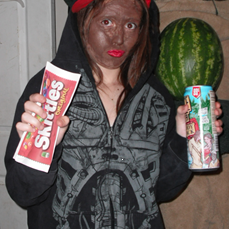
The disregard for Black life, and the disparagement of Black death is nothing new; the pleasure and joy garnered from Black suffering and dreams deferred has been central to White supremacy throughout United States history. Evident in minstrel shows, the history of lynching, and jokes about racial profiling or the war on drugs, whites have always found joy in the violence experienced by African Americans.
The history of American public discourse is one marred with both the erasure of black and suffering, and efforts to find happiness and pleasure in the suffering of the OTHER. We saw this during Hurricane Katrina where the sight of African Americans wading through water in search of food or medicine, or stranded families clinging to life on roof tops elicited reactions of shock and horror as well as pleasure and joy at the knowledge that could never happen to White America. Dylan Rodriguez describes Katrina as a “scene of white popular enjoyment, wherein the purging/drowning of black people provided an opportunity for white Americana to revel in its entitlement to remain relatively indifferent to this nearby theater of breathtaking devastation.”
Such joy isn’t simply an outgrowth of the denied humanity of Black people or the refusal to witness and see Black pain, but it is also a celebration of, or at least the solidification of, White humanity, White power, and the protective armor that whiteness provides each and every day. This is the story of race in America, from lynchings to Katrina, from slavery to Trayvon Martin.
But the examples of racialized disregard that have surrounded Trayvon Martin’s death, most recently exemplified in the commodification and “meme-ification” of the tragedy by various White people. This marks a startling new mechanization of racism wherein there has been a complete evacuation of humanity…on both sides, that of people of color and other marginalized groups, the dehumanization of which is, sadly, no longer surprising, but also that of dominant groups who willfully participate in acts of oppression like “Trayvoning” whose humanity becomes increasingly and insidiously taken over by consumption and performance. The joy historically, as well as contemporaneously, taken by many Whites in the violence against and suffering of African Americans has become nearly indistinguishable from the joy of consuming.
The consumer market has overtaken all facets of social interaction, the good, the bad, and the very bad. We are witnessing a descent into a “society of the spectacle” that perhaps Guy DeBord himself could scarcely imagine. The spectacularizing of racialized events and tragedies within the 21stcentury, while still largely constructed through sociocultural lenses of White supremacy, racialized inferiority, and histories of racial injustices and violences, allows for their translation to be conveniently dislocated from these racial phenomena and displaced onto the assumed “neutral” projects of commodity and consumption. As DeBord stated regarding the nature of the society of the spectacle, “The spectacle cannot be understood as an abuse of the world of vision, as a product of the techniques of mass dissemination of images…It is a world vision which has become objectified.”
Writing about the practice of whites collecting body parts as souvenirs during lynchings, Harvey Young, in “The Black Body as Souvenir in American Lynching,” highlights the spectacle of white-on-black violence and the pleasure derived from Black suffering and death. He describes the lynching of Sam Hose in 1899, where, “the assembled crowd descended upon his body and collected various parts of it assouvenirs.” Seeking to explain the unexplainable, to provide meaning to the unthinkable, Young identifies this history in the following way: “lynched black body in the aftermath of the lynching event and variously read it in terms of the souvenir, the fetish, and the performance remain.” He argues, “that the lynching keepsake not only can be defined by, but also can exceed, each of these three terms. Containing within itself the various features of the souvenir, the fetish, and the remain, the body part recalls and remembers the performance of which it is a part. It not only gestures toward the beliefs that motivated its theft, but also renders visible the body from which it was taken.”
It would seem that the efforts to recreate Trayvon’s death, to trivialize his death by including skittles and ice tea, and then disseminate this image within the new media sphere continues the history of rendering Black death as souvenir. “For white supremacists, souvenir lynching photos became ways of reliving the erotic thrills of torture and mutilation produced under the guise of righteous civic actions, as well as a way of reaffirming a racial and gendered hierarchy that kept white men on top and blacks at the bottom,” writes Dora Apel in “Torture Culture: Lynching Photographs and the Images of Abu Ghraib.” She furthers that, “When lynching photos were transformed into souvenir postcards, they were sent to friends and family with the senders' proud boasts of having been in the mob, making blackness an exotic spectacle and privileging the ‘look of whites over blacks. Spectacle lynchings similarly relied on the look of the crowd to reaffirm notions of superior white ‘manliness’ over the stereotype of the hyper sexual black male”
In this historical example we see the explicit rendering of White supremacy. The White supremacy and racism of the act, purposefully done as the dual act of White superiority and Black inferiority, as well as of the racist and violent talisman provided by the souvenir, was never obfuscated. It was seen as a right. It was claimed. In the new millennium, a time heavily invested in the belief in its own racial progress, while remaining heavily mired in colorblind racism and reimagined racial violences, the rampant consumer society, fortified incalculably by new media, makes the claims to White supremacy, (for all but the most extreme), almost completely deniable. The claims become subsumed beneath the “logic” of the spectacle wherein “the spectacle aims at nothing other than itself.” (DeBord) This is the sociocultural state in which “Trayvoning” exists, the state of the self-referential spectacle.
Thus “Trayvoning” creates a community bound by whiteness and the ability to “become” Trayvon through the dehumanizing ritual, through the spectacle of Black death, and through recasting his murder apart from white supremacy and whiteness. While his murder, his death, and the circumstances that surround the injustice are understood as a site of White ritual and pleasure, a space of White pleasure resulting from Black pain, they are not transparently claimed (by and large) as such. While the trend can be interpreted as a new technology of lynching, its character remains separate from lynchings of the past whose act, and the dissemination of lynching photographs highlighted White power and White supremacy.
The ability to “act” like a dead Trayvon Martin only to get up and head back into White suburbia is illustrative of this same feeling of power and privilege, but invisibly so. White people don’t take part in “Trayvoning” to “declare” White supremacy; they take part in it because the declaration has been rendered unnecessary by various sociocultural, sociopolitical, and socioeconomic forces. In fact, the absence of the explicit claims to it emphasizes the power and privilege even more. It reflects an unstated joy at the lack of possibility of getting suspected as a criminal for merely walking to a convenience store; it reflects an unacknowledged level of pleasure in knowing that being stopped for walking while White is less likely than a visit to Newt’s moon colony; it reflects a flaunting of the power and privilege that grants Whiteness protection from armed security guards, an unwilling/reluctant criminal justice system, and a media culture more concerned with convicted Trayvon Martin than George Zimmerman. The ability to stand up and walk away after the photo indicates the power of whiteness.
“Trayvoning” is thus akin to a history of racial cross-dressing and minstrelsy, practices that, according to Eric Lott, embodied white desire “to try on the accents of ‘blackness’ and demonstrates the permeability of the color line.” He writes that blackface “facilitate[s] safely an exchange of energies between two otherwise rigidly bounded and policed cultures.” The ability to imagine and embody Trayvon in death is a source of pleasure because it not only provides whites with the opportunity to “try on” and “control” blackness but to reassert their whiteness. Whereas Trayvon is dead, whiteness lives on.
Much of the media discourse has likened “Trayvoning” to planking or “Tebowing,” emphasizing the phenomena as a spectacle, as yet another example of youth culture, the ease that pictures are disseminated on the Internet, or how trends come about. Yet, while “Trayvoning” is certainly a disturbing phenomenon of spectacle, these comparisons are absurd at so many levels because neither “planking” nor “Tebowing” rely on, perpetuate, and relish in Black death; these practices don’t find recreation in the re-creation of black suffering nor do they produce souvenirs to remember the death of Trayvon Martin.
“Trayvoning” is but another moment in a larger history of racial violence, and white efforts to establish a segregated community based on power and pleasure, commodification and deniability. One can only hope, based on the resistance and condemnation these pictures have elicited, that those thinking about “Trayvoning” will simply skip steps 1-6 and go right to step #8: humanize death, ANY death, instead of spectacularizing it; and continue to protest racial injustice in this form…and in all its forms.
***
Lisa Guerrero is Associate Professor of Comparative Ethnic Studies at Washington State University Pullman, editor of Teaching Race in the 21st Century: College Professors Talk About Their Fears, Risks, and Rewards (Palgrave Macmillan, 2009) and co-author of African Americans in Television, co-authored with David J. Leonard. (Praeger Publishing, 2009).
David J. Leonard is Associate Professor in the Department of Critical Culture, Gender and Race Studies at Washington State University, Pullman. He has written on sport, video games, film, and social movements, appearing in both popular and academic mediums. His work explores the political economy of popular culture, examining the interplay between racism, state violence, and popular representations through contextual, textual, and subtextual analysis. Leonard’s latest book After Artest: Race and the Assault on Blackness was just published by SUNY Press in May of 2012.
Kamis, 24 Mei 2012
The Savior Syndrome: Patrick Willis and the Mystique of #WhiteLove
 |
| Patrick Willis' Two Dads | Ruth Fremson, NYTimes |
The Savior Syndrome: Patrick Willis and the Mystique of #WhiteLove
by David J. Leonard | NewBlackMan
There is an epidemic of white love in America. From The Blind Side and The Help to Kony 2012, George Clooney saving Africa and countless white celebrities liberating black children via adoption, white love has become the antidote to the race problem of the twentieth century. Whereas “the race problem” defined the last years, the next 100 years are purportedly to be one of white love. While racial profiling and the prison industrial complex, persistent discrimination and poverty, education and health disparities continue to plague the nation amid a climate of heightened anti-black racism, immigrant scapegoating, and a rising tide of white nationalists movements, white love offers a ray of sunshine. Better than Barack Obama’s “hope we can believe in,” in the face of so much injustice “white love” is hope (white) society can believe in each and every day.
While watching The Blindside Elon James White highlighted the power of white love within the much celebrated film and society at large:
I DID NOT KNOW WHITE WOMEN COULD CREATE FOOTBALL STARS WITH 16 WORDS. THEY ARE MAGIC. THEY SHOULD BE TAUGHT AT HOGWARTZ!
See--poor Black dude is actually full of talent and wisdom--he just needs a healthy dose of White love to open his eyes. #WHITELOVE
What #TheBlindside teaches us is if White people find poor homeless Black dudes they can create highly sought after football stars.
Awww snap. Kathy Bates and Sandra Bullock are doing a Awesome White Lady TAG TEAM. Hitting him with #WhiteLove left & right...
Dear White People: Please bottle #WhiteLove & sell it. Then we could throw it out of car windows in the ghetto like malatov cocktails...
#WhiteLove is so magical the child of awesomely White Sandra Bullock is smarter & more savy than the poor black dude 10 yrs his senior.
Every White person in this family is AMAZING. The Dad who wasn't even paying attention to poor black dude is now INSPIRING him.
I don't want to watch this movie anymore. I HAVE DEADLINES--but #WhiteLove is drawing me in... I WANT SANDRA BULLOCK SAVE ME.
The power of white love isn’t unique to Hollywood fantasy but is commonplace within sport culture. This particular fantasy was on full display during a recently re-aired episode of ESPN’s E:60. Documenting the trials and tribulations of the 49ers Patrick Willis, whose life took him from a Trailer Park in rural Tennessee to the fame and fortune of the NFL; from poverty and abuse to the American Dream.
The “rags-to-riches” and pulling oneself up by shoelaces is nothing new to sports culture given the centrality of the American Dream and sports as economic escalator within sports media. Yet, the presented story of Willis is one less about the Protestant work ethic and more of white love. The story isn’t so much of his talent, hard work, intelligence, but the transformative power of whiteness, whereupon Willis life changed when he became part of a white family.
The story given on ESPN and elsewhere is rather simple: Willis and his siblings grew up poor in Tennessee. As a result of their mother leaving them and their father’s drug and alcohol problems, a difficult childhood became one of great pain and suffering because of physical abuse. Ultimately standing up to his father by first responding to the abuse and then telling school officials, the children faced the prospects of being split apart. This would never come to fruition as Willis’s coach, Mr. Findley, after a request from the school superintendant, agreed to take all 4 children into their home.
No longer subjected to violence and poverty, yet together as a family, Willis began to thrive on and off the field. According to E:60, he no longer needed to focus on “basic needs” because of his father’s addiction or fending him beatings but instead could be a “normal child.” He was now able concentrate on himself on and off the field. Allowing Willis for the first time to experience love and a true childhood, Willis blossomed into an exceptional football player and even better story. The narrative frame that imagines blackness as pollutant and danger, as problem, juxtapose to whiteness as savior, as help, as goodness, and love is wrought with history and meaning. The only better than Hollywood’s vision of white love is the purported real thing.
Yet, at the same time it celebrates the power of whiteness, the narrative offered celebrates poverty and injustice as the basis of his drive, the foundation of his work ethic, and the impetus for his success. “Boss [Patrick Willis] has never been one to cry, at least not in front of Orey, his 8-year-old brother. Folks around tiny Bruceton, Tenn., say he's 10 going on 25. The kid plays tackle football against men and does all the cooking for his motherless family,” wrote Bruce Feldman a few years back. “During the summer he's out of the house by 6 a.m., gone to chop cotton on the other side of the county in sticky 95° heat. For that, he gets blisters the size of bottle caps on his hands and $110 a week. Orey, baby brother Detris and little sister Ernicka don't call him Boss without good reason.”
In “Patrick Willis: 49ers Star Overcomes Mind-Blowing Adversity on Road to Glory,” Ryan Rudnansky furthers this celebration of injustice as part of his ultimate success: “Given the circumstances of his youth, Willis could have easily quit early. He could have easily slipped down the wrong slope. Instead, Willis used it as motivation to not repeat the same mistakes his father made. Now he has a mansion and a place for his family to visit.” In other words, the poverty the family experienced, the pain he experienced because his mother deserted him and because of his father’s abuse, and the responsibilities that led him to cook and work in the cotton fields at an early age is the reason why he is so successful as athlete and person. His drive and passion comes from these terrible circumstances.
The fetishizing of poverty and the implicit celebration of social ills and injustice as the necessary path to the American Dream is a telling reframing of privilege and opportunity. The absence of opportunities and adversity in the end provides the requisite discipline and work ethic needed to succeed. That plus a little help from benevolent white saviors are the tickets to the promise land. Poverty plus white love are the requisite tools for the American Dream. The hegemony of a narrative of white saviors and romanticized adversity should be of little surprise given its cultural power evidence by The Blindside.
The opening moments of The Blindside establishes it’s overtly racial narrative with amazing clarity. Michael Oher is traveling with a friend, who is hoping for admission into an upscale catholic school; they are leaving a world of poverty and violence within Memphis heading right for an upper-class suburb. As Oher moves from world to the next, the film juxtaposes images of black poverty and despair in opposition to those of white fathers playing ball with their kids. Opportunity exists elsewhere and Oher nearly needed to leave a world of pain and suffering behind. Whereas other black youth would likely be subjected to scrutiny from security and profiling from police responsible for protecting and serving the white middle-class, Oher easily moves into the white world because he is lovable and different.
Michael is acceptable and even desirable because he isn’t threatening (unlike his peers); he is helpless and hopeless – someone in need of saving by white love. He is welcome to enter the white world because not only does he need to be saved and because he is a validation of the superiority of whiteness but because he is safe, lovable, and just not like the others. He is “mute, docile, and ever-grateful to the white folks who took him in.” As noted by Thaddeus Russell, Oher is imagined as a black saint who protects his white family and his white quarterback from danger. More importantly, he is a saint because he is different. “Though raised in Memphis housing projects, he uses no slang and dislikes the taste of malt liquor. Instead of Ecko and Sean John, he wears Charlie Brown-style polo shirts,” writes Russell. “His table manners are impeccable. He exhibits virtually no sexual desire. He is never angry and shuns violence except when necessary to protect the white family that adopted him or the white quarterback he was taught to think of as his brother. In other words, Michael Oher is the perfect black man.”
While still needing white help, Michael, like Patrick Willis, deserves this help because unlike the OTHER they are “the perfect black men.” His perfection will in the end redeem white America, from the Touhys' to the millions of white Americans celebrating this film, from Patrick Willis adopted family to the millions of fans who celebrate his story.
Central to each of these representations is their inscription of sport (and whiteness) as an instrument of values, as a vehicle for opportunity, and as a source of white love. As C. Richard King and I argued in Visual Economies of/In Motion, sports films, including those spots on ESPN, “hails citizen-subjects: at once, they can, with ease and almost complete transparency, inspire audiences, champion individualism and the American dream, reinscribes common sense ideas about race, gender, and sexuality, comment on social issues, and rework the past” (p. 3).
The spot on Patrick Willis and The Blindsidehighlight the imagined place of sports (football) as a bridge between the black and white world, as a source of unification between these disparate worlds, and as ultimately the source of the American Dream. While some may scoff or deny this analysis, noting the truthfulness of these stories, yet the question remains why are these stories told and not others, one not bound together by white love and white saviors. In the end, what’s white love got to do with?
***
David J. Leonard is Associate Professor in the Department of Critical Culture, Gender and Race Studies at Washington State University, Pullman. He has written on sport, video games, film, and social movements, appearing in both popular and academic mediums. His work explores the political economy of popular culture, examining the interplay between racism, state violence, and popular representations through contextual, textual, and subtextual analysis. Leonard’s latest book After Artest: Race and the Assault on Blackness was just published by SUNY Press in May of 2012.
Kamis, 17 Mei 2012
Jim Crow University?: The State of Racial Tolerance on America’s Campuses

Jim Crow University?: The State of Racial Tolerance on America’s Campuses
by David J. Leonard | NewBlackMan
Racial slurs; racist graffiti; taunts and jeers; nooses hanging from doors; and blackface. No, I am not talking about the South circa 1960, but the climate of America’s colleges and universities. If you look around the country, it would seem that some want to take our colleges back to the Jim Crow era when schools and curriculum were white only.
In the last two months of the mockery of post-race America has been quite evident. The “N word” was scrawled on a dorm room and a bathroom at Fordham University. That same month, students at University of Wisconsin-Madison hurled bottles and racial slurs at two African American students who had the audacity to walk past THEIR fraternity house on THEIR campus. At Cornell University, black students walking through campus faced a barrage of racial epithets, flying bottles and catcalls of “Trayvon.” At the Ohio State University, since April, racist and anti-religious epithets have been found on a dorm room door and within the community, including the defacement of a mural of President Barack Obama. These incidents followed the appearance of “Long Live Zimmerman” on a campus building.
For white students the college experience is defined by parties, football games, and new experiences; for students of color it is one often defined by hostility, racist violence, and the same old experiences. Last year, “All N-word's must die” was found at Williams College. At University of Alabama, a white student screamed a racial slur at a white student, with slurs popping up on campus sidewalks. At Murray State, a faculty member chastised a black student for arriving 15 minutes late to a film screening, noting, “slaves never show up on time.” And the list of incidences goes on and on. This is the sort of racism and violence that has become all too common at America’s liberal institutions of higher education, those places often praised as the breeding ground for the post-racial millennial generation.
Latinos, Asian Americans, and Native Americans also face an increasingly racially hostile environment evidence in cowboy and Indian parties, anti-immigrant chants at basketball games, and countless other examples. While certainly more visible as a result of the power of social media, racism is obviously nothing new to America’s colleges and universities. Whether looking at the history of integration or the practice of “ghetto parties,” institutions of higher education have a long history of racial injustice.
Students of color and faculty of color experience this history each and every day. According to Howard J. Ehrlich, director of The Prejudice Institute, between 850,000 and one million students (roughly 25 percent of students of color and five percent of white students) experience racially and ethnically-based violence (name calling, verbal aggression, harassing phone calls and “other forms of psychological intimidation”) each year. And this only reflects what is reported and what is seen. As Leslie Picca and Joe Feagin have discovered with Two-Faced Racism: Whites in the Backstage and Frontstage, white students use the n-word and tell racist jokes with frequency, a reality that impacts the culture and environment of America’s colleges and universities.
The Jim Crow signs remain visible even as conservatives whine about liberal universities and the discrimination of conservative students. I haven’t seen any Bigots and Liberal parties, or groups of conservative student subjected to catcalls and slurs. There hasn’t been an assault on white history and literature, which remain central to the college experience.
It is also increasingly difficult for ethnic studies, evidence in the attacks on Mexican American Studies in Arizona or the recent blog post in the Chronicle of Higher Education. Excoriated as a “cause not a course of student,” and denounced as “promoting resentment toward a race or class of people” the white only signs are being constructed in classrooms and in college communities throughout the country. These unwelcome signs demonstrate a lack of commitment to and value in diversity, but also how the presence of students of color and the practices of African American and other ethnic programs challenges the very privileges of whiteness.
“What I've learned most explicitly about the often racist depictions of Back Studies at primarily White institutions, is that it is a by-product of the on-going project of the discipline to make explicit connections to the work that we do and the communities of folks that exist beyond the four walls of the classroom,” notes Mark Anthony Neal. “Even as some Black Studies faculty are no invested in such a project--and such a project looks very different now than it did during the 1960s, Black Studies continues to reject that idea that it exists in a vacuum.” The continued attacks on the fields of ethnic studies and students of color makes this all too clear.
***
David J. Leonard is Associate Professor in the Department of Critical Culture, Gender and Race Studies at Washington State University, Pullman. He has written on sport, video games, film, and social movements, appearing in both popular and academic mediums. His work explores the political economy of popular culture, examining the interplay between racism, state violence, and popular representations through contextual, textual, and subtextual analysis. Leonard’s latest book After Artest: Race and the Assault on Blackness was just published by SUNY Press in May of 2012.
Langganan:
Postingan (Atom)