Tampilkan postingan dengan label Social Justice. Tampilkan semua postingan

Minggu, 25 November 2012

Mark Anthony Neal @ UMass-Amherst on Thursday November 29th


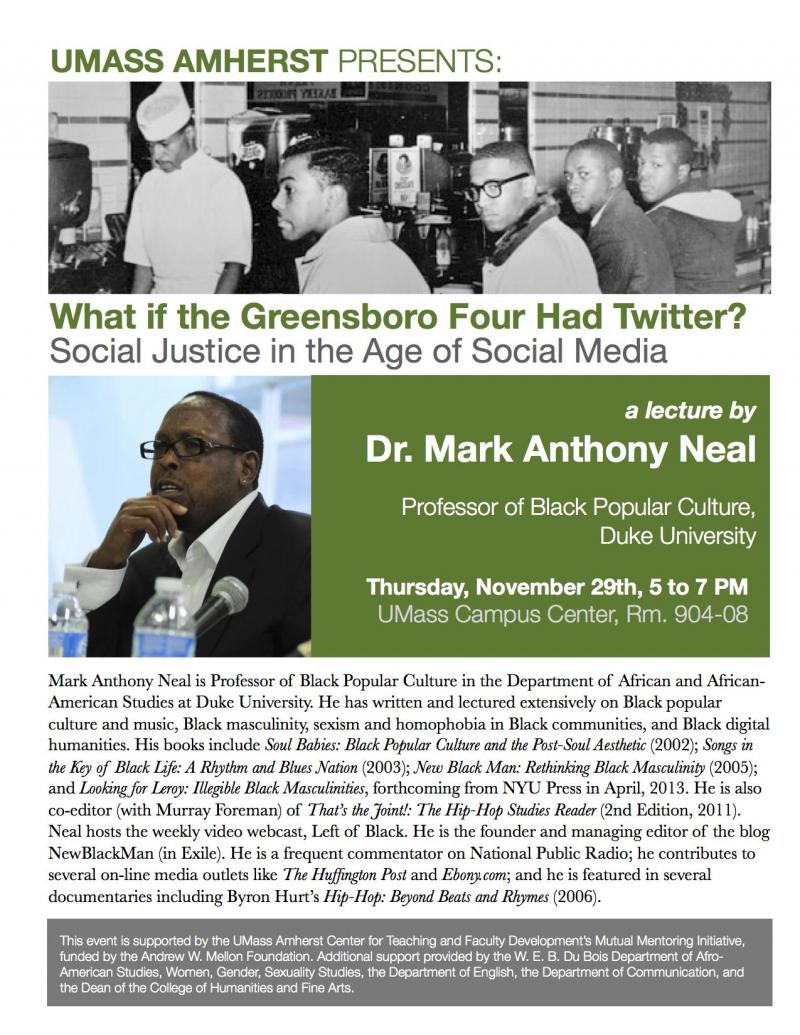
Duke University Scholar to Discuss ‘Social Justice in the Age of Social Media’ Nov. 29

Duke University professor Mark Anthony Neal will give a lecture titled “What if the Greensboro Four Had Twitter? Social Justice in the Age of Social Media” on Thursday, Nov. 29 at 5 p.m. in 904-08 Campus Center.

Neal is professor of black popular culture in the department of African and African-American studies at Duke. He has written and lectured extensively on black popular culture and music, black masculinity, sexism and homophobia in black communities, and black digital humanities. His books include Soul Babies: Black Popular Culture and the Post-Soul Aesthetic (2002); Songs in the Key of Black Life: A Rhythm and Blues Nation (2003); New Black Man: Rethinking Black Masculinity (2005); and Looking for Leroy: Illegible Black Masculinities, forthcoming from NYU Press in April. He is also co-editor (with Murray Foreman) of That’s the Joint!: The Hip-Hop Studies Reader (2nd Edition, 2011).

Neal hosts the weekly video webcast Left of Black. He is the founder and managing editor of the blog NewBlackMan (in Exile) and a frequent commentator on National Public Radio. He also contributes to several online media outlets like The Huffington Post and Ebony.com, and he is featured in several documentaries including Byron Hurt’s Hip-Hop: Beyond Beats and Rhymes.

The event is supported by the Center for Teaching and Faculty Development's Mutual Mentoring Initiative, funded by the Andrew W. Mellon Foundation. Additional support provided by the W.E.B. Du Bois Department of Afro-American Studies; Women, Gender, Sexuality Studies; Department of English, Department of Communication and the dean of the College of Humanities and Fine Arts.

Senin, 22 Oktober 2012

Left of Black S3:E6 | Color-Blind Racism in the Obama Era


Left of Black S3:E6 | October 22, 2012

Color-Blind Racism in the Obama Era 

Left of Black host and Duke Professor Mark Anthony Neal is joined in the Left of Black studios by Eduardo Bonilla Silva, Professor of Sociology and Chair of the Sociology Department at Duke University.  Neal and Bonilla-Silva, the author of the now classic Racism without Racists: Color-Blind Racism and the Persistence of Racial Inequality in the United States, discuss the Obama Presidency, the importance of a social justice politics, and the insidiousness of “color-blind” racism.

***

Left of Black is a weekly Webcast hosted by Mark Anthony Neal and produced in collaboration with the John Hope Franklin Center at Duke University.

***

Episodes of Left of Black are also available for free download in  @ iTunes U


Sabtu, 08 September 2012

Got Solutions? Beyond Denial and Toward Transformation (Part 2)


Got Solutions? Beyond Denial and Toward Transformation (Part 2)
by David J. Leonard | HuffPost BlackVoices

As I noted in part 1, white denial about racism and demands for solutions (for the racial injustices often dismissed) go hand in hand. As Mark Anthony Neal brilliantly reminded people in a Facebook status update: "The very essence of 'privilege' is when you enter into a space and are fundamentally unaware that not only have you changed the conversation, but have made the conversation about you." 

Beyond attempting to turn the conversation into what they want, what these demands fail to recognize is white denial about racism, male denial about sexism, and heterosexual denial about homophobia is problematic and is instrumental in the perpetuation of violence, inequality, and privilege. While I remain wary of the demands for solutions, especially in absence of a willingness to work toward social change and accountability, there are many individual and systemic changes that will not only foster greater equality and justice but will address historically produced inequalities. There is much that can and must be done as part of a movement of racial reconciliation and change.


Universal Health Care: A consequence of America's history of racism, violence, segregation, wealth disparity, and inequality represents stark differences between life and death. Whether looking at life expectancy, infant mortality, and countless illness, we see that racial inequality has consequences. In other words, racism kills. To combat the health consequences of American Apartheid, we must adopt a single-payer national health system. The grave impact of a Jim Crow system of "health care" is seen each and every day. According to a recent study from Harvard University, "Nearly 45,000 people die in the United States each year -- one every 12 minutes -- in large part because they lack health insurance and can not get good care." Race matters here. Tim Wise notes that each year 100,000 African Americans die "who wouldn't if black mortality rates were equal to that of whites." Universal health care would not solve these disparities but it would certainly dramatically intercede against racism's assault on the basic human right of life. Lesley M Russell makes this clear:

Racial and ethnic minorities make up more than half of America's uninsured and they suffer higher rates of chronic illness than the general population. They are more likely to experience risk factors that predispose them to chronic illnesses such as obesity, and are much less likely to receive preventive screenings, regular care, and to fill needed prescriptions that could prevent or ameliorate their conditions. Because being uninsured often means postponing needed heath care services, people of color are diagnosed at more advanced disease stages, and once diagnosed, they receive poorer care. Inevitably, they are sicker and die sooner.

A single payer system may not be a complete solution but it is a way to save lives, improve lives, and challenge the ongoing history of racism. Who is on board? It would seem that providing health care and dismantling America's prison nation is the ultimate fulfillment of family values. You want a solution, how
about respecting and valuing every person's family; now that's some values I can get on board with.

While we are nationalizing things, how about we abandon the inequitable local funding formulas employed by school districts and ensure that equity and equality is maintained in each and every school district. Since I know everyone is interested in change, how about a higher education that is open and accessible to everyone.

Solutions are a-plenty. Abolish the Electoral Collegeand move toward publicly funded elections.

There are of course many solutions, from the Dream Act to dramatically changing the tax code and increasing minimum wage would take us on a path toward equality, justice, and racial reconciliation. If you want solutions, join me in fighting for them: if people get to deduct mortgage payments from their taxes, how about rental tax deductions; if children are deductible what about no children? Free childcare for all; what about public transformation in every community - interested? An end to the war on drugs and the military industrial complex! Are these the solutions you had in mind?

I could go on for pages, but I am wondering if these are the solutions you had in mind. Yet, what I have in mind is an end to the war on drugs, the war on women, and the war on the poor; or maybe a program that actually works to address poverty and homelessness. How about a societal commitment to end rape culture; ready to help by showing zero tolerance for the criminalization, shaming and demonization of rape victims? Are those the solutions you are so interested in hearing about? You ready to commit to protecting the vote for every citizen with equal zeal as many fight for the right to bear arms? I don't know about you, but to me surely making voting easier than it is to get an assault weapon in some locales would be both a step in the right direction and solutions in itself.

Solutions abound; policy initiatives, personal transformation, and a willingness to listen, dialogue, and look inward are solutions. And while I don't think the requests for solutions are always genuine, every proposal, suggestion, and potential solution is one that is possible. Yet, we don't have to look any further than our history books to find solutions, to find pathways toward freedom and justice. "On the one hand we are called to play the Good Samaritan on life's roadside; but that will be only an initial act. One day we must come to see that the whole Jericho road must be transformed so that men and women will not be constantly beaten and robbed as they make their journey on life's highway," notes Martin Luther King. "True compassion is more than flinging a coin to a beggar; it is not haphazard and superficial. It comes to see that an edifice which produces beggars needs restructuring." Or we can simply fulfill the demands of the Black Panther Party: "We want land, bread, housing, education, clothing, justice, peace and people's community control of modern technology."

***

David J. Leonard is Associate Professor in the Department of Critical Culture, Gender and Race Studies at Washington State University, Pullman. He is the author of the just released After Artest: Race and the War on Hoop (SUNY Press) as well as several other works. Leonard is a regular contributor to NewBlackMan, layupline, Feminist Wire, and Urban Cusp. He is frequent contributor to Ebony, Slam, and Racialicious as well as a past contributor to Loop21, The Nation and The Starting Five. He blogs @No Tsuris.
Senin, 07 Februari 2011

'Left of Black': Episode #20 featuring Bakari Kitwana and Kyra Gaunt


Left of Black #20
w/Bakari Kitwana & Kyra Gaunt
February 7, 2011

In this 20th installment of Left of Black, host Mark Anthony Neal is joined by author, political analyst and activist Bakari Kitwana in a conversation about the current media landscape. Neal also talks with Baruch College Professor and 2009 TED Fellow Kyra D. Gaunt whose recent essay Black Twitter, Combating the New Jim Crow & the Power of Social Networking examines the social justice potential of Social Media.

→Bakari Kitwana is a journalist, activist and political analyst. He’s currently senior editor of newsone.com, the internet news presence of Radio One. He’s also the CEO of Rap Sessions: Community Dialogues on Hip-Hop, which conducts town hall meetings around the country on difficult dialogues facing the hip-hop generation. Kitwana is the author of The Hip-Hop Generation: Young Blacks and the Crisis in African-American Culture (2002) and Why White Kids Love Hip-Hop: Wangstas, Wiggers, Wannabees and the New Reality of Race in America (2005).

→Kyra D. Gaunt is a trained ethnomusicologist and classical singer who teaches the study of African American music, cultural anthropology, hip-hop, race and gender studies. A 2009 TED (Technology, Entertainment, Design) Fellow, Gaunt is Associate Professor in the Department of Sociology and Anthropology at Baruch College. She is the author of The Games Girls Play: Learning the Ropes from Double-Dutch to Hip-Hop (NYU Press, 2007)

***

Left of Black is a weekly Webcast hosted by Mark Anthony Neal and produced in collaboration with the John Hope Franklin Center at Duke University.

Jumat, 04 Februari 2011

It’s not the Public Internet, It is the Internet Public


It’s not the Public Internet, It is the Internet Public
by Dave Parry

Last night Gladwell published this short piece for the New Yorker. Gladwell revisits his earlier essay which argued that the ties produced by social media (weak ties) are not as important as social ties produced by face to face iteration (strong ties), and thus social media is not a particularly advantageous platform for fermenting social change. While I disagree with much of that essay, it seems worth investigating/considering, the degree to which social ties produced by social media are substantially different from those which develop from relationships not mediated thru social media. Bizarrely though, his most recent post actually suggests something quite different. Rather than argue that social media has effects on social organization (replacing strong ties with weak ones), Gladwell argues that social media is of little to no-consequence:

“But surely the least interesting fact about them is that some of the protesters may (or may not) have at one point or another employed some of the tools of the new media to communicate with one another.”

The point for Gladwell is that asking how the revolution happens is the “least interesting” question one can ask. Again bizarrely this seems to contradict his earlier piece which argued that “how” a revolution happened was of crucial importance for understanding the nature of the ties people develop. It would seem that the only consistency between these pieces is an attempt to downplay the significance social media plays in social movements, indeed arguing that it either doesn’t help, or is of no relevance. The first Gladwell is worth considering, the second less so.

But where Gladwell misses in this second article is realizing that the discourse has shifted, moved beyond does social media cause a revolution, to how does the existence of social media change the warp and the woof of a social movement. This question is far more interesting, and far more important. The “Twitter Caused the Revolution” headlines have been more or less replaced by more nuanced accounts of “what role did social media play in these protests.” Few have been willing to argue that social media is not part of the equation here, or that social media’s role is not worth investigating. This strikes me as a fairly substantial shift from the “Iran = Twitter Revolution” headlines of a year and a half ago. Indeed, I have even detected a subtle shift from the Tunisia analysis, whereby understanding of social media’s role has become more nuanced and refined. I have spent the better part of two days now reading thoughts and blog posts from various places around the web attempting to learn what others have to say about these events and I see little evidence from academics and leading thinkers in the field that Twitter = democracy arguments are still alive. (Even CNET argued that there is no such thing as a social

To be sure “cyber-utopism” as a discourse is still a dangerous and prevalent myth. Indeed all one has to to is see recent comments by Iranian activist and noble prize winner Shirin Ebadi, who said, “So, I can tell you that thanks to technology dictators can’t get a good nights sleep,” to realize that the belief that social media = social justice is alive and well. Clinton’s 21st century statecraft ideology is alive and well.

I think it is also important to distinguish here between the analysis of social media and the Egypt uprising, I and you, are likely reading, and the one that still circulates amongst people who are not particularly and specifically invested in the matter. That is I think if you asked people who do not spend hours a day on Twitter, or reading articles on the web written by experts on the subject, the impression might be distinctly different. I have had numerous conversations (four in the airport alone on Sunday) with people who all articulated the belief that social media was largely responsible for the uprising, and that do to social media we are likely to see all of Africa revolt, and demand democracy, a cascade effect produced by the internet. Which is to say, that although the debate has for the large part moved past cyber-utopism, the effects of that debate still linger. And in this respect it is not the internet that matters so much as how we talk about the internet (see Thesis One of Morozov’s book).

But that doesn’t account for the most recent article by Gladwell, indeed it makes said article even more academically irresponsible by recasting and repeating a debate that most (all) experts have moved past. Gladwell misses an opportunity to help develop questions about the role of social media in pursuit of social justice, instead choosing to play the “nothing new here, move along” card. One doesn’t correct for the cyber-utopic discourse that still exists by utterly dismissing the effects of the medium under discussion. This just creates the “yes it is,” “no it isn’t” debate which has proved not only inadequate, but at least partly responsible for the less than effective social media foreign policy. We need better.

Read the Full Essay @ Profound Heterogeneity